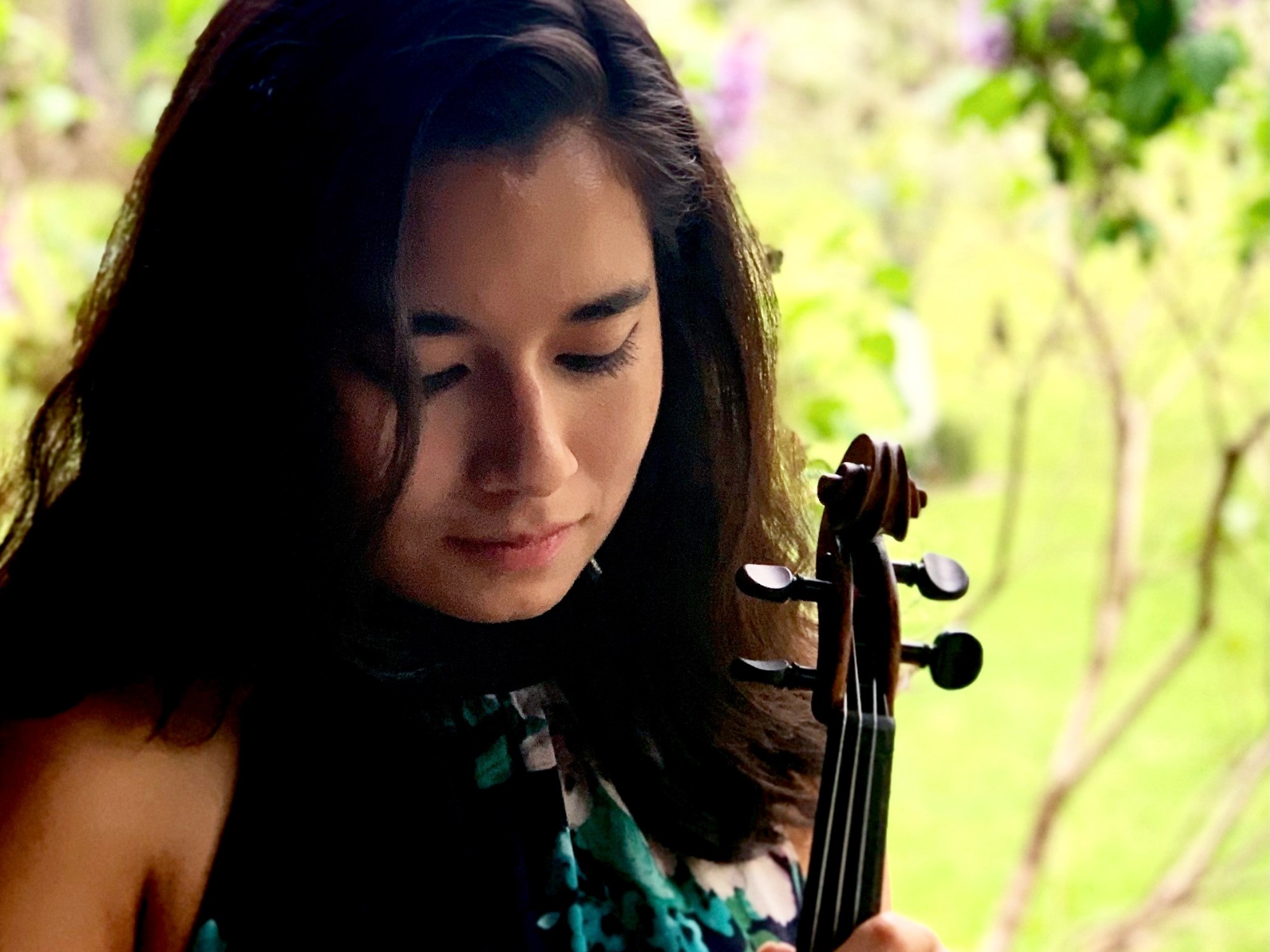

“My mom did not let me hold a violin until I was 3 years old”.
Photo by Jiyang Chen
A conversation with Per Tengstrand
When Hana Mundiya was ten years old, her parents gave her a book by the violinist Arnold Steinhardt called “Violin Dreams”, where he writes about his journey with Bach’s most famous piece for solo violin, the Chaconne in d-minor. The book also had a CD: it included the Chaconne in two versions with the same violinist, recorded forty years apart.
“As a kid listening to the CD, I was overwhelmed by the sheer virtuosity and length of the piece. I had just started learning the Bach solo violin works, and even though I was only a child, I was fascinated by what it means to live with a piece of music. Fifteen years later, it was the first work I turned to as we went into lockdown in March of 2020 — and I know that in a couple decades, my life will still be revolving around the Chaconne.”
When Hana takes the stage at the Victor Borge Hall on the first of December to play this masterpiece, she likes to recall what Beethoven said about Bach and his music for solo violin: “I believe that Bach’s solo works for violin are perhaps the greatest example in any art form of a master’s ability to move with freedom and assurance, even in chains.”
“This is what I think of the Chaconne,” she says.
An interesting thought: the Chaconne starts with a slow Sarabande-like rhythm, the same rhythm as in Beethoven’s Egmont Overture, one of the main music works in the film of the evening.
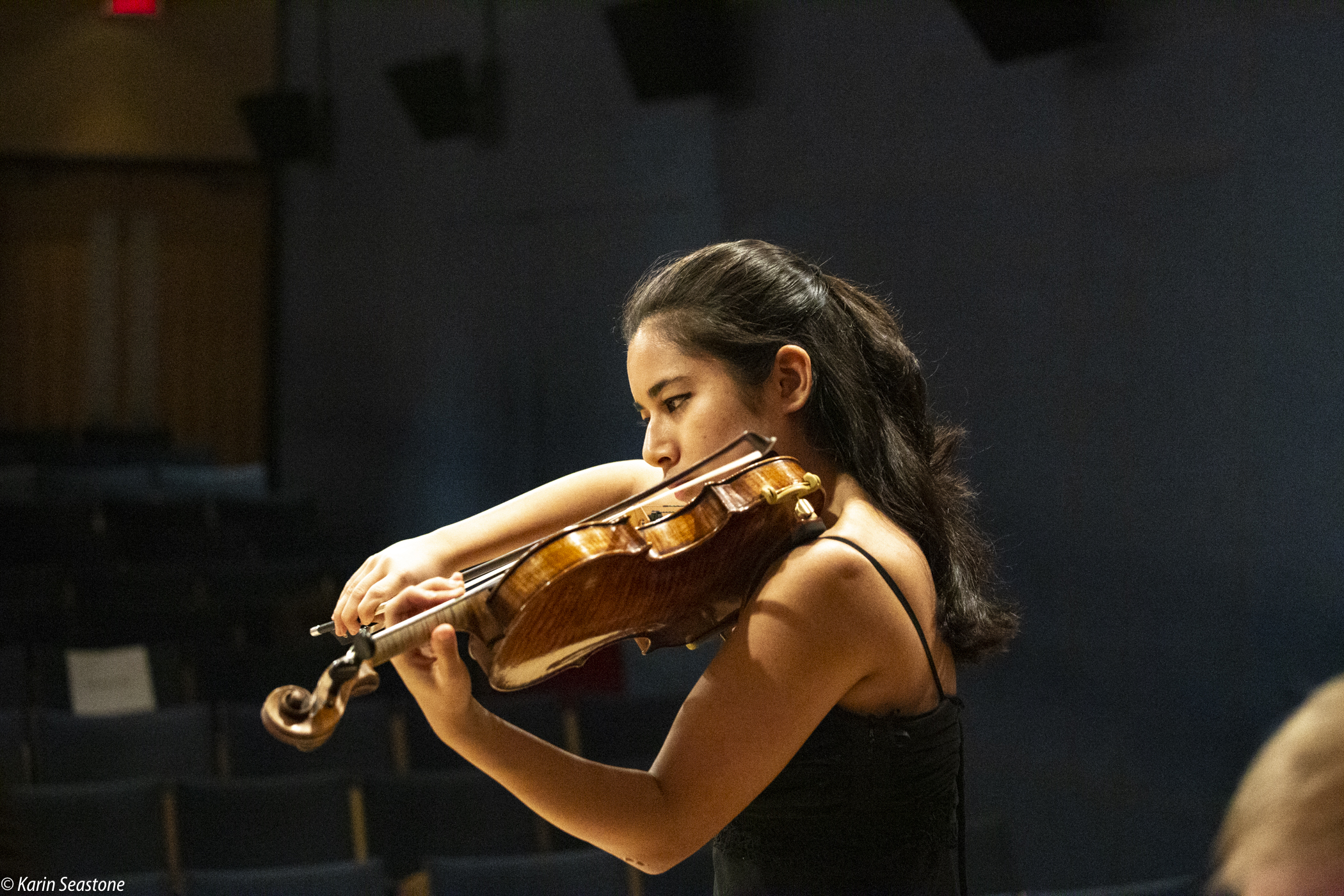
Hana Mundiya has achieved a lot already in her young life and career. Coming from a truly diverse background with family roots in India, Pakistan, Japan, and England, her parents met in New York City where she was born.
“My mom is a classically trained violinist; she would play the violin for me when I was a child, and naturally, I wanted to try. But she did not let me hold a violin until I was 3 years old.”
Not until she was 3… She says it with a straight face – although it sounds like it could be a joke. But starting very early is often a necessity in elite level classical music training.
When I first reached out to the OPUS chamber group a few years ago, Hana was the president of the group and she was my first contact with what I endearingly call “The Princeton kids.” She was clearly on a path to become a professional musician, but had taken four years to study Japanese and French literature and to get a broader view of life, a view that can be very narrow if you lock yourself in a little practice room eight hours a day.
“It was certainly a challenge to find balance with both music and the other subjects. But I believe that studying at Princeton broadened my view of the world and gave me perspective on time, and time management. My graduate program at Juilliard started during the peak of the pandemic. When my classes started remotely, it was all up to me to decide how I wanted to schedule my days. This was a huge contrast from the never-ending deadlines and external pressure at Princeton. With all of this new freedom, it was a privilege as a musician to be able to focus solely on my development, and to dig deep into the repertoire.”
Hana was close friends with the violist Katie Liu and the cellist Leland Ko at Princeton. Together with them, I played Brahms’ G-minor Piano Quartet at Scandinavia House and in Sweden. It was Robin Park, a cellist now at Princeton (who will perform in the series in March) who told me… “That kind of level in a group of three string players will never happen again at Princeton.” I agree.

Since that performance at Scandinavia House, tell us what you have been up to?
“Well first I want to say that it’s great to be back! For the last few years I have been trying to crystallize my personal vision as a musician — I’ve realized that amidst all of the turmoil in this world, music is one of very few things that has consistently survived through history.
I have discovered the beauty of fundamental works by composers such as Beethoven and Bach. I also perform contemporary works by living composers, and it has been enlightening for me to juxtapose them with classics; my relationship with music has given me insight into the role that art plays in times of crisis. As for the future, first and foremost, I will be performing, mostly in New York City, both in solo and chamber music concerts. While I enjoy curating and programming, I’d like to keep sharing my music to communicate, to provide a space for people to reflect on their lives and on the power of music.”

In the film, Hana plays the first movement of the Kreutzer Sonata, which is filmed in the Victor Borge Hall. Since it was filmed during the pandemic, the team consisted of only Hana, me and Stefan Bensaid who helped with the lighting. It was a challenging day for everybody involved. Every shot had to be prepared with lighting and cameras and it could often mean waiting for a long time between takes. Twelve minutes of music took a whole day to record and film. For the musician, the problem can easily become one of having to turn the performance on and off: play – wait, play – wait.
“I felt that if I focus on the cameras, I could become stiff. So, I imagined that we were playing to a real audience in a concert. With the Beethoven Kreutzer Sonata, a piece that is so exciting, passionate, and alive, my goal was to recreate the same kind of atmosphere as we would want our audience to experience in a live performance.”‘
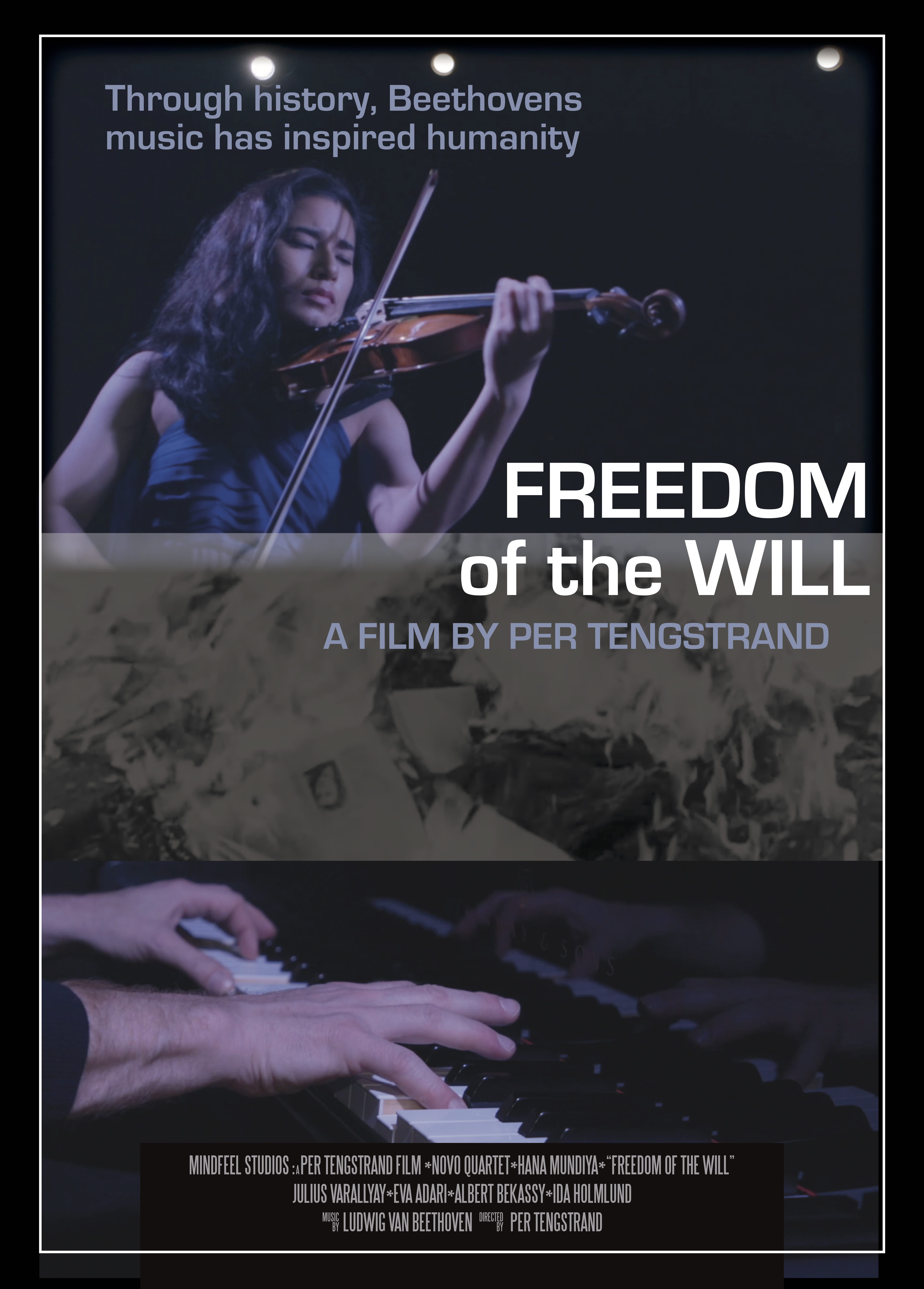
A few days ago, Hana watched Freedom of the Will at a test screening, and to my relief she sincerely seemed to like the film.
“I have never seen anything like it. The film is moving, enlightening, aesthetically beautiful – and, of course, it’s full of wonderful music. It is about something I care so much about: that music has the power to change our lives – and that it has the extraordinary power to move and heal. I am a member of the United Nations Chamber Music Society: building relationships around the world, performing with friends and colleagues onstage, and meeting new people from various cultural backgrounds, inspires me as a violinist.”
One final question: you have been to Sweden twice, how did you like Scandinavia?
I loved it! It makes it even better that we performed the Kreutzer Sonata for the first time in Sweden.
And I have to say — my favorite time of day is “Fika”!”
 Music On Park Avenue